For decades, the U.S. Navy’s supercarriers — equipped with advanced F-35C and F/A-18 fighter jets — have been the world’s most powerful symbol of naval strength. That unchallenged dominance is now being tested.
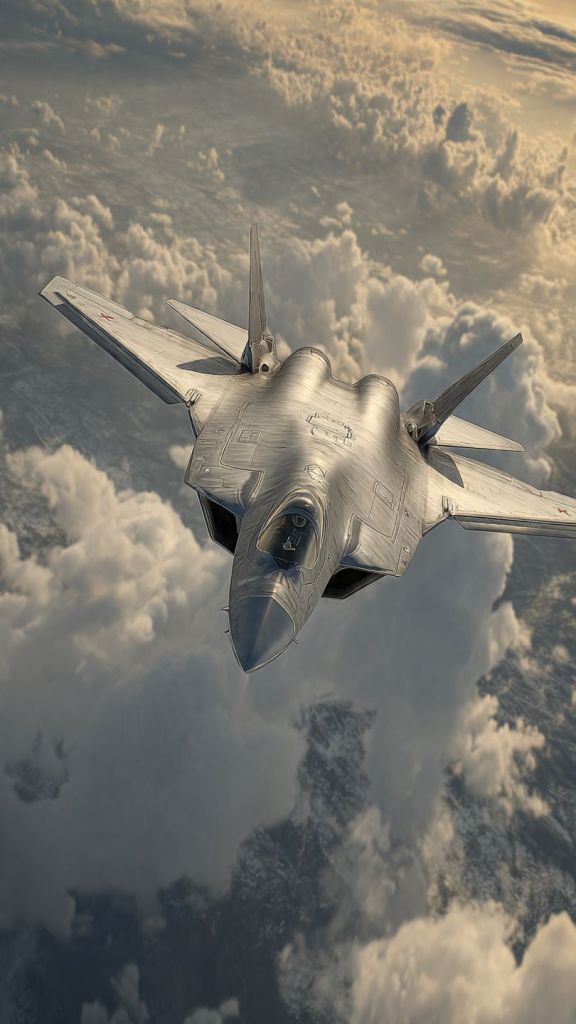
Defense analysts and recent satellite imagery confirm that China’s Shenyang J-35 stealth fighter is now fully deployed across all three People’s Liberation Army Navy (PLAN) aircraft carriers. This is more than a technical achievement — it marks a significant shift in the balance of military power across the Indo-Pacific region.
From Prototype to Full Fleet Deployment
The J-35’s development has been swift and deliberate. It was built to replace the older J-15 “Flying Shark,” a non-stealth fighter that was always considered inferior to the American F-35C in modern aerial combat. The J-35 is now operational on all three Chinese carriers:
Liaoning (Type 001): Originally a refurbished Soviet-era vessel regarded mainly as a training ship, the Liaoning has been significantly upgraded. With J-35s now on board, it has become a credible combat platform capable of projecting power throughout the South China Sea.
Shandong (Type 002): China’s first domestically built carrier is now operating a mixed fleet of older J-15s alongside the new J-35s, demonstrating that the two aircraft can work together effectively during flight operations.
Fujian (Type 003): China’s most advanced carrier, equipped with a modern electromagnetic launch system (similar to that used on U.S. Navy carriers), allows the J-35 to take off with a full weapons and fuel load. This unlocks the aircraft’s full combat capability and brings the Fujian to a level technically comparable to America’s newest Ford-class carriers.
A Genuine Threat, Not Just a Copy
Western analysts have long debated whether the J-35 is simply a reverse-engineered imitation of Western designs or a truly capable warplane. Its fleet-wide deployment settles that debate — the aircraft works, and it works at scale.
The J-35 is designed to neutralize one of the U.S. Navy’s greatest advantages: its superior sensor and surveillance network. The aircraft is equipped with an advanced radar system, a 360-degree situational awareness system for the pilot, and an internal weapons bay that can carry the long-range PL-15 air-to-air missile. Rather than engaging in close-range dogfights, the J-35 is built to target high-value U.S. support aircraft — such as radar planes and aerial refueling tankers — from long distances, effectively degrading a carrier strike group’s ability to see and respond to threats.
The J-35 is also designed to work within China’s broader military network. It serves as a frontline data-gathering platform, relaying targeting information to land-based ballistic missiles — including the DF-21D and DF-26, both designed specifically to strike aircraft carriers. Any U.S. carrier group operating in the western Pacific must now account for the possibility that it is being tracked by stealth aircraft capable of guiding a coordinated missile strike.
The Numbers Are Shifting
The strategic picture is growing more challenging for the United States. While the U.S. Navy operates 11 aircraft carriers, only a portion are available for deployment at any given time. China’s three carriers, by contrast, operate close to home — well within reach of their own land-based air defenses, missile systems, and supply networks.
Should a conflict arise over Taiwan or territorial disputes in the South China Sea, China would no longer be committing outdated aircraft against superior American technology. It would be deploying stealth fighters, supported by advanced land-based jets and hypersonic missiles, against U.S. forces that could potentially be outnumbered and outranged in the opening days of a conflict.
Perhaps most significantly, the United States has lost its monopoly on stealth technology at sea. The F-35C remains the world’s most capable carrier-based fighter, but the technological gap between it and the J-35 has narrowed considerably. The element of surprise that stealth once guaranteed American forces can no longer be taken for granted.
What to Watch Next
The J-35’s full operational deployment sets the stage for several developments that U.S. defense planners are closely monitoring:
Production Scale: China’s manufacturing capacity may allow it to produce J-35s at a rate that outpaces American F-35 production, which is already facing supply chain pressures.
Drone Integration: The next likely step is pairing the J-35 with unmanned wingman drones — a concept the U.S. Navy is still working to develop and deploy operationally.
Nuclear-Powered Carriers: The J-35’s success is expected to accelerate development of China’s rumored next-generation nuclear-powered carrier (Type 004), which would give China the ability to project power globally, not just regionally.
The image of a J-35 launching from a Chinese carrier is not simply a propaganda victory for Beijing. It is a clear signal that the era of one-sided American stealth dominance in the Pacific is over. The competition for air superiority over the world’s most strategically important ocean has become, for the first time, a genuinely two-sided contest.
 Tech + 360
Leave a comment